A study from Cambridge University really caught my eye this week. The study, published in the British Educational Research Journal, found that Rosalind Franklin is the only female scientist named in GCSE and equivalent science exam specifications across the UK. Yes, that is right—just one! n = 1!
And the irony is not lost on me that as the only woman named in terms of historical scientists, Rosalind Franklin’s remarkable discoveries about DNA were infamously credited to men at the time, with her true recognition only coming much later, too late.
It doesn’t really get much better as we climb the educational ladder. At A-levels, AS-levels, National Highers, and Advanced Highers, only 3 women are mentioned out of a total of 181 scientists – a whopping 1.66%! The thing is, this just doesn’t represent the reality. I appreciate that there is only so much room or hours of teaching in the curriculum, but there are plenty of incredible historical female scientists, meaning this is neither a true nor accurate reflection of history. We should be ashamed that it has been allowed to happen.
The report initially made me angry, though perhaps acknowledging that anger is a learning opportunity in itself. Surely now exam boards will review their content with urgency and change it to rightly recognise more diversity in the examples they pick to educate our young people. As a science educator who works with students regularly (admittedly not school children, but typically young people), this study got me thinking about how we teach, how we shape the imaginations of the next generation, and the historical context we provide them with.
I am very lucky. I get to teach hundreds, if not thousands, of science students, helping them understand complex knowledge, theories, and equations alongside coaching them in transferable skills like presenting, critical analysis, and discussion. My students are typically young people who have recently left school or college. More often than not, they are self-selecting as scientists. They likely had positive experiences of science in school, they were fortunate enough to have inspiring teachers, or they may have had higher “science capital,” hopefully with parents supportive of their decision to pursue science as a discipline at university.
The Default Setting: A Disturbing Pattern
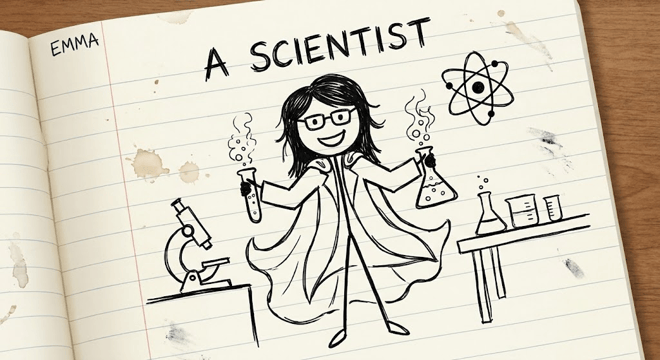
The lack of representation in the scientists mentioned by name in curricula connects directly to a famous social science experiment: The “Draw a Scientist” Test.
For decades, when researchers asked young children to simply “draw a scientist,” the overwhelming majority (both boys and girls) drew a man. And they usually drew a male figure with glasses, wild hair, and a lab coat, because they thought that is what scientists looked like.
We thought this stereotype was finally changing, because over recent years, the percentage of children drawing a female scientist has increased significantly. That’s fantastic progress! But seeing the results of this Cambridge study concerns me. I worry we could be sliding backwards. If our children are taught that scientific breakthroughs and innovation belong to and are almost exclusively down to men, the old default mindsets understandably creep back in. I worry that if we were to repeat this experiment with young people who have been taught to this syllabus, they are understandably likely to draw men, because that is what they have been taught.
This bias starts alarmingly early, too. Landmark psychological research (such as the study led by Lin Bian) has shown that by as young as age 6, girls become significantly less likely than boys to associate words like “brilliant” or exceptional intelligence with their own gender. When our educational materials continually showcase men as the sole architects of genius, they inadvertently reinforce these very stereotypes.
Why This Matters for Everyone (Boys Included!)
When we talk about representation in relation to this study, it’s easy to slip into thinking this is solely an issue for girls. But the truth is, I think this is just as problematic for boys, in fact it’s problematic for everyone.
When boys grow up in a world where history presents science as a purely male domain, it sends a skewed, narrow message about who innovates, who owns intellect, and who shapes the future. It robs boys of seeing female intellect as foundational, and it robs girls of seeing themselves reflected as scientists. A lopsided, biased, and unrepresentative syllabus cheats every student out of the full, rich, brilliantly collaborative reality of how exciting science truly is.
Diversity Isn’t a Box-Ticking Exercise
Diversity in science (and in life!) is a fundamentally good thing because innovation doesn’t happen in an echo chamber. Different perspectives, varied backgrounds, and unique lived experiences are the exact ingredients needed to solve complex global problems. We know that diverse teams produce better solutions.
When we curate history to feature only a single demographic, we flatten the story of human progress. When we open up the narrative and ensure it reflects true diversity, suddenly science isn’t just an intimidating list of names to memorize for an exam; it becomes a vibrant, human adventure that belongs to and can be advanced by everyone.
There Are So Many Brilliant Examples Waiting in the Wings!
In some ways, we don’t have to look hard to fix this. There are countless phenomenal women whose scientific breakthroughs shaped the modern world and whose stories are bursting with inspiration.
Classrooms already have the pleasure of learning about Rosalind Franklin, whose meticulous X-ray diffraction images were the bedrock of discovering the DNA double helix. But there are so many other options too! What about Lise Meitner, who provided the theoretical explanation for nuclear fission, only for her male colleague to take home the Nobel Prize? Think of Jocelyn Bell Burnell, who as a postgraduate student discovered pulsars, yet was famously left off the Nobel Prize awarded for her work. Do you see a pattern emerging? Perhaps we should educate our young people about this pattern as well as the science.
And that’s just scratching the surface! From Dorothy Hodgkin unlocking complex protein structures to Stephanie Kwolek inventing Kevlar, history is overflowing with trailblazing female scientists that our children should be learning about at school.
We often like to think that the “problem” of Women in STEM is sorted, but this research shows that clearly it isn’t!
Rewriting the Future
Education is our blueprint for the future; it is how we develop our upcoming generations. By simply expanding the cast of characters we introduce to students in science and beyond, we change the energy of the classroom. Because it is often said that you cannot be what you cannot see. By including diverse examples in curricula, we send a powerful, important message to every student sitting at those desks staring at a science textbook: Your curiosity matters. Your brilliance belongs here. You can do it too.
So, let’s ask for change and champion a more complete, vibrant, and diverse telling of science history. Because when everyone is invited into the story of scientific discovery, the future shines a whole lot brighter.
Let’s demand better,
Emma x
P.S. I couldn’t write this blog post and not mention a brilliant book by award-winning psychologist and absolute legend Prof. Madeleine Pownall. Absent Minds: The untold story of the women who changed psychology forever, explores how even fields dedicated to understanding the human mind have long overlooked their female pioneers. It’s a systemic cultural blind spot, and it needs fixing everywhere.

