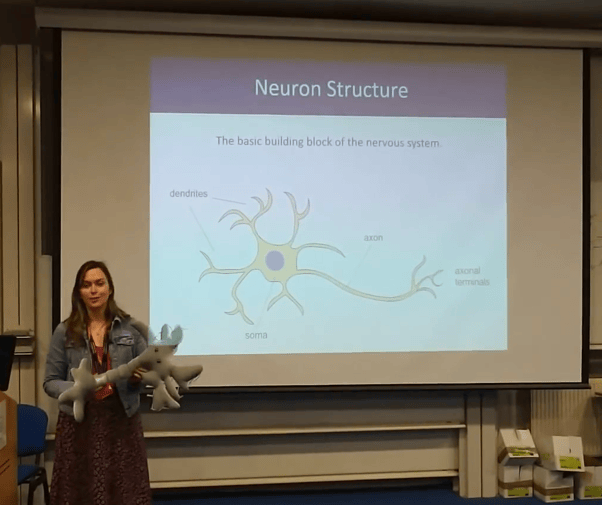
I have had the privilege of lecturing for a long time now and I still absolutely love it. It really is a genuine privilege to be able to play a small part in helping others learn, to see things differently and ultimately to bring a bit of joy to their day (and don’t we all need that from time to time!).
That being said, and I think this is really important, even as a National Teaching Fellow (NTF), Principal Fellow of Advance HE (PFHEA), and someone who is very grateful to have won lots of awards for teaching, my lectures have not always gone well – a shocking revelation you might say! Don’t get this twisted: I will always give my lectures my absolute best, no matter what. That is a non-negotiable for me. But, even as a lecturer, I am continually learning, reflecting, growing and taking risks to help others learn in my lectures, that is one of my favourite parts of my job.
Today’s blog isn’t going to reflect on the relative benefits or issues of lectures themselves as a pedagogic tool, for the purposes of this post, we have to accept them for what they are. But, as we kick off another new term, I wanted to reflect on my time lecturing and importantly on how scary it can be to deliver lectures.
I was recently reminded of exactly this when I was having computer issues immediately before I was due to deliver a 9am lecture. It was a drizzly Wednesday morning and the technology was failing. While the technician was kindly tinkering with the lectern to try and fix the issues, he looked up at the hundreds of students staring back at him and nervously said “woahhhhh, that is a lot of people”. So, with that in mind, I want to reflect on how scary delivering lectures can be and provide some top tips, to help anyone who is feeling those nerves at the moment, because, spoiler alert, those nerves are all very normal.
Know your audience
As an educator and science communicator, my biggest top tip, is know your audience. Have a think about your audience, in this case your students. What level of learning are they at? You will need to teach a topic differently in first year and final year for example. It may also be worth considering what entry requirements your course has. We have students from all over the world, joining us with a range of entry-level qualifications. Their subject knowledge may differ depending on not only their subject qualifications, but also the exam boards which they studied under and what was on the syllabus.
Once you have considered this, you may need to modify your content, and don’t be afraid to tell your students this. I often use phrases such as “for some of you this may be revision, but I want to ensure that we are all on the same page”. In a large class, there will inevitably be variability in prior learning and understanding and through your lectures, you have an opportunity to ensure that everyone’s knowledge base is the same, because that is a fair and equitable approach and you don’t want to leave anyone behind. And let’s face it, sometimes, repeating content to confirm understanding is no bad thing, it is nice to be reminded of the fact you understand content before you learn a load of new stuff.
Top tip: before you write any content, consider what the background knowledge of the class and your students is likely to be.
Crowd control
Something I wasn’t quite aware of before standing up at the front of a lecture theatre, is just how it feels to have hundreds of eyes staring back at you, very nerve-wracking. The nerves really start going, particularly if you have any students who are copying down everyone word that comes out of your mouth as if it is gospel, that is a lot of pressure. But let’s reframe that pressure. I often like to think of my friends who are musicians and comedians, they would be ecstatic to have a crowd of this size!
Crowd control is a skill in itself. Over the years, I have learnt to set out my expectations pretty early on. I am aware that my teaching style is relatively informal and fun, and if that isn’t managed carefully, some people can really test that style. So, I am clear with students about respect for both me as a lecturer and for their peers. I state that if people push those boundaries, we may not be able to learn in these fun and interactive ways, which would be a real shame for everyone. But sometimes, challenging behaviours can happen. If someone begins talking in a lecture theatre, that sound can travel, and if it isn’t managed appropriately, that might lead to someone else beginning to chatter and before you know it, the volume in the lecture hall is at an all-time high and you cannot be heard.
Be clear with students from the outset on your expectations and then rein back in any behaviour which challenges these expectations. Don’t be afraid to pause the lecture, say “I can hear some chatter, that is distracting me and I am sure it is distracting others, so please could we all quieten down so I can continue with my lecture.” The first time you do this, it may feel really scary. I remember the first time I did it, I could feel my heartbeat in my mouth.
It takes practice knowing when to do this, and how much to let go versus call out. You certainly do not want to be doing it every two minutes, and if that is happening, whatever you are doing probably isn’t working, so it may need a rethink. But once you have mastered politely telling students to quieten down, you can insert a pause. It will seem like ages, even when it isn’t, but it can have a brilliant effect on crowd control.
Importantly, we are often not taught crowd control skills and techniques as lecturers. More often than not, we are subject-specific experts, but we are not given any insights or help with how to teach or manage the behaviour of hundreds of people in a lecture theatre. Crowd control is something that you very much learn to manage on the job, but nonetheless these are hugely important skills for helping maintain a positive learning environment. And crowd control doesn’t always have to be quietening down a crowd, in some instances I actively encourage noise, testing out demonstrations and cheering, as long as it falls within the agreed expectations and the learning environment is such that everyone in the room can learn in a positive and engaging way.
Top tip: set expectations for the learning environment early on and if you notice poor behaviour, call it out.
Nerves show you care.
As someone who teaches students about the nervous system, it is tempting to provide a biological explanation as to why you might feel nervous standing up in front of hundreds of students to give a lecture, but I shall resist that temptation.
Instead, I want to share that I used to lose a lot of sleep before delivering lectures, particularly new lectures. While I lose less sleep as I have become more experienced, I still have a restless night before delivering new lectures and the occasional anxiety dream. Ultimately, I think that is because I care and if I ever go into a lecture theatre not caring, I would be even more worried.
The bottom line is that nerves show you care and when they are harnessed and acknowledged, they can be used effectively to help you deliver lectures well while looking after your wellbeing too. I always bring water to a lecture theatre because that horrible dry throat feeling has a habit of catching me by surprise. The other thing about nerves is they encourage you to speed up, which isn’t great for you or your students. If you are nervous, suddenly a 50 minute lecture can be rattled off in 30 minutes. So, be mindful of the time and always slow down. Pause, have a drink of that water and enjoy the position that you are in as much as you can, you have worked so hard to be here and you have a real opportunity to help others.
The thing is, you never really know how well (or not) a lecture will go until you deliver it and even then, different cohorts have different energy levels and vibes, so it may vary from year to year. So, embrace those nerves, try to learn how to harness them so that they don’t impact your sleep too much and remember, you can only give it your best.
Top tip: slow down, remember your water and embrace the nerves, they show you care.
50 minutes is a long time
A typical lecture slot in my institution is 50 minutes long and that is a long time! When is the last time you can honestly say that you sat down and fully concentrated on something for 50 minutes without any distractions? We also know that attention spans are shrinking and the world is full of distractions, so I never think of my lecture as 50 minutes. I see every lecture as distinct chunks of maybe 10-15 minutes max, with blocks of learning, then checking understanding. You can add multiple choice questions, interaction, encouragement of discussion in small groups. These are all ways to help your audience keep engaged with new knowledge while checking their understanding.
The other thing that academics have a habit of doing is leaving the very complex content until the very end of the lecture. I know that I am guilty of this. The time when you are rushing to finish, because we all know someone else will be knocking at the door for their teaching session immediately afterwards. While you absolutely want to build knowledge up, be mindful of leaving all of the complex content until the very end when you are rushing to finish. I try to break the lecture into halves so that complexity is sandwiched into the middle when students (and I) aren’t flagging too much.
Top tip: don’t see your lecture as a 50 minute block, break it up into chucks.
It will never be perfect
As a recovering perfectionist, acknowledging that my lecture will never be perfect is something that I still struggle with. But the honest truth is, your lectures may never be perfect, particularly if you are your own worst critic. Although, I will admit I still get a rather wonderful buzz when a lecture has gone well, I can always pick holes in any lecture that I have delivered.
Over the course of my career, I have experienced some howlers during my lectures. Huge technology failures, blancmange brains not setting and ending up with a puddle for a brain (oh the irony!), bubble guns that haven’t… bubbled.
I have accepted that in trying to do things differently, risk comes with the territory. More often than not I let the students know where the jeopardy may lie in my lectures. I tell them it may go wrong, it adds to the interest and as long as they understand what was meant to happen, the learning outcome will still be met. Yes, I may look a bit silly, and it may not have been delivered perfectly, but that is okay, because I tried and I think that the students appreciate the efforts that I have gone to to enhance their learning experience, even if it doesn’t work perfectly every time.
Top tip: let go of perfection, your best is good enough.
Ask for feedback, as long as you really want to hear it.
Higher Education can be full of metrics and measures, and student feedback can fall under that category. I want to acknowledge the huge biases that can exist in student feedback. It is well established that student feedback disproportionately impacts minority groups, for example women and ethnic minority educators. As a white woman, I have received comments on my hair, the way I dress and my makeup! Not only did these comments not relate in any way to my teaching, but they also made me self-conscious and upset me.
Now I proactively ask my students for feedback, but I am also prepared that when I open it some of the comments may not be relevant. The other thing to acknowledge is that you will never please everyone (and yes, I know that is a sad and important realisation to come to). Given I have over 550 students in a typical lecture, some think my pace is too slow, others think it is too fast. I suspect I am probably somewhere in the middle on a typical bell curve. But my point is, when you ask for feedback, often what people are really asking for is praise, and while that is lovely, it may not help you to improve. I encourage open and honest feedback on my teaching so that I can improve it for the future, as that is what good feedback should be about, improving for next time.
Top tip: feedback is important, but it only says so much
Teaching is both a skill and a privilege
And finally, we all acknowledge that things are pretty tough in Higher Education right now. While my thoughts on the lack of recognition and appreciation for teaching-focused careers and colleagues I will save for another post, I want to acknowledge that the ability to teach well is a skill in itself. If you love teaching and are good at it, that is amazing and will absolutely be appreciated by your students. So yes, I may be up late-night cramming and losing a bit of sleep before I deliver my new lectures, but I still feel it is an utter privilege to be able to inspire the next generation and to help them understand complex topics in fun and engaging ways.
Best of luck for the start of the new term everyone!
Emma x